Peer Review Process
PEER REVIEW PROCESS
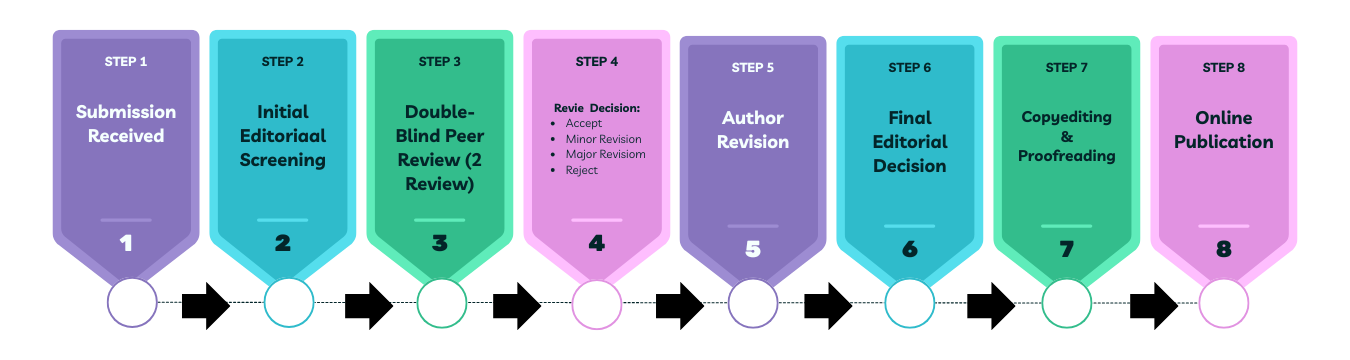
LawSains Journal menerapkan sistem double-blind peer review. Dalam proses ini, identitas penulis tidak diberitahukan kepada reviewer dan identitas reviewer tidak diberitahukan kepada penulis. Setiap naskah ditelaah oleh sekurang-kurangnya dua reviewer independen yang memiliki keahlian sesuai dengan bidang kajian naskah.
LawSains Journal applies a double-blind peer review system. Under this system, the authors’ identities are not disclosed to the reviewers, and the reviewers’ identities are not disclosed to the authors. Each manuscript is reviewed by at least two independent reviewers with expertise relevant to the subject matter of the manuscript.
-
Penerimaan dan Pemeriksaan Teknis Naskah
Submission and Technical Check
Penulis mengirimkan naskah melalui sistem Open Journal Systems (OJS) LawSains Journal. Tim editorial memeriksa kelengkapan berkas, kesesuaian format, metadata penulis, pernyataan orisinalitas, dan kepatuhan terhadap Author Guidelines.
Authors submit their manuscripts through the LawSains Journal Open Journal Systems (OJS). The editorial team checks the completeness of the submission files, formatting, author metadata, originality statement, and compliance with the Author Guidelines.
-
Pemeriksaan Awal oleh Editor
Initial Editorial Screening
Editor melakukan pemeriksaan awal untuk menilai kesesuaian naskah dengan Focus and Scope jurnal, kualitas akademik, struktur penulisan, kebaruan, serta kepatuhan terhadap etika publikasi. Pada tahap ini, naskah juga diperiksa tingkat kemiripannya dengan menggunakan perangkat pendeteksi kemiripan. Naskah yang tidak sesuai dengan ruang lingkup jurnal, tidak memenuhi standar minimum akademik, atau melanggar etika publikasi dapat ditolak tanpa dikirimkan kepada reviewer.
The editor conducts an initial assessment of the manuscript’s conformity with the journal’s Focus and Scope, academic quality, structure, originality, and compliance with publication ethics. At this stage, the manuscript is also examined using similarity-detection software. A manuscript that falls outside the journal’s scope, does not meet the minimum academic standards, or violates publication ethics may be rejected without being sent for peer review.
-
Penunjukan Reviewer
Reviewer Assignment
Naskah yang lolos pemeriksaan awal dikirimkan kepada sekurang-kurangnya dua reviewer independen. Reviewer dipilih berdasarkan keahlian, pengalaman akademik, kesesuaian bidang kajian, dan tidak adanya konflik kepentingan dengan penulis maupun penelitian yang dinilai.
Manuscripts that pass the initial screening are assigned to at least two independent reviewers. Reviewers are selected based on their expertise, academic experience, relevance to the manuscript’s subject matter, and the absence of any conflict of interest with the authors or the research under review.
-
Proses Double-Blind Peer Review
Double-Blind Peer Review
Selama proses penelaahan, identitas penulis dan reviewer dirahasiakan dari masing-masing pihak. Reviewer wajib menjaga kerahasiaan naskah serta tidak menggunakan informasi, data, atau gagasan yang terdapat dalam naskah untuk kepentingan pribadi. Reviewer menilai orisinalitas, relevansi topik, ketepatan metode penelitian, kekuatan argumentasi, kualitas analisis, penggunaan sumber rujukan, kejelasan penyajian, dan kontribusi naskah terhadap pengembangan ilmu hukum.
Throughout the review process, the identities of the authors and reviewers are concealed from each other. Reviewers must maintain the confidentiality of the manuscript and must not use any information, data, or ideas contained in the manuscript for personal purposes. Reviewers assess the manuscript’s originality, relevance, research methodology, strength of argument, quality of analysis, use of references, clarity of presentation, and contribution to the development of legal scholarship.
-
Rekomendasi Reviewer
Reviewer Recommendations
Berdasarkan hasil penelaahan, reviewer dapat memberikan salah satu rekomendasi berikut:
a. Diterima tanpa revisi;
b. Diterima dengan revisi kecil;
c. Memerlukan revisi besar dan penilaian ulang; atau
d. Ditolak.
Rekomendasi reviewer menjadi bahan pertimbangan bagi editor. Keputusan akhir mengenai penerimaan atau penolakan naskah merupakan kewenangan editor.
Based on the review, reviewers may provide one of the following recommendations:
a. Accept without revision;
b. Accept with minor revisions;
c. Major revisions and re-evaluation required; or
d. Reject.
Reviewer recommendations serve as the basis for editorial consideration. The final decision to accept or reject a manuscript remains the responsibility of the editor.
-
Revisi oleh Penulis
Author Revision
Penulis wajib memperbaiki naskah sesuai dengan komentar dan rekomendasi reviewer. Naskah hasil revisi harus disertai dokumen tanggapan yang menjelaskan setiap perbaikan yang telah dilakukan atau alasan akademik apabila suatu rekomendasi tidak diterapkan.
Penulis diberikan waktu paling lama 14 hari kalender untuk menyelesaikan revisi, kecuali editor menentukan jangka waktu lain berdasarkan tingkat perbaikan yang diperlukan. Keterlambatan tanpa pemberitahuan dapat menyebabkan proses pengajuan dihentikan.
Authors must revise the manuscript in accordance with the reviewers’ comments and recommendations. The revised manuscript must be accompanied by a response document explaining each revision made or providing an academic justification when a recommendation is not followed.
Authors are given a maximum of 14 calendar days to complete the revisions unless the editor specifies a different period based on the extent of the required revisions. Failure to submit the revision within the specified period without prior notice may result in the discontinuation of the submission process.
-
Penilaian Ulang dan Keputusan Akhir
Re-evaluation and Final Decision
Editor memeriksa kelengkapan dan kualitas perbaikan yang dilakukan oleh penulis. Naskah yang mengalami revisi besar dapat dikirimkan kembali kepada reviewer untuk dinilai ulang. Editor kemudian menetapkan keputusan akhir berupa diterima, memerlukan revisi tambahan, atau ditolak.
The editor evaluates the completeness and quality of the revisions made by the authors. A manuscript requiring major revisions may be returned to the reviewers for further evaluation. The editor then issues the final decision to accept the manuscript, request additional revisions, or reject it.
-
Penyuntingan, Tata Letak, dan Pemeriksaan Akhir
Copyediting, Layout, and Proofreading
Naskah yang telah diterima menjalani proses penyuntingan, penyesuaian gaya selingkung, pemeriksaan bahasa, penataan tata letak, dan pemeriksaan akhir. Penulis dapat diminta memeriksa naskah versi proof sebelum diterbitkan. Perubahan substansial tidak diperkenankan pada tahap ini, kecuali atas persetujuan editor.
Accepted manuscripts undergo copyediting, journal-style adjustment, language editing, layout preparation, and final proofreading. Authors may be requested to review the proof version before publication. Substantial changes are not permitted at this stage unless approved by the editor.
-
Publikasi Daring dan Frekuensi Penerbitan
Online Publication and Publication Frequency
Artikel yang telah menyelesaikan seluruh proses editorial dan produksi diterbitkan secara daring dengan akses terbuka. LawSains Journal diterbitkan tiga kali dalam satu tahun, yaitu pada bulan April, Agustus, dan Desember.
Penempatan artikel dalam suatu edisi ditentukan berdasarkan selesainya proses penelaahan, revisi, keputusan editorial, dan produksi. Naskah yang belum menyelesaikan seluruh proses tersebut sampai dengan penutupan suatu edisi akan dipertimbangkan untuk edisi berikutnya. LawSains Journal tidak menerbitkan edisi atau artikel secara mundur hanya untuk memenuhi frekuensi penerbitan.
Articles that have completed the editorial and production processes are published online under an open-access model. LawSains Journal is published three times a year, in April, August, and December.
The placement of an article in a particular issue is determined by the completion of the peer-review, revision, editorial decision, and production processes. A manuscript that has not completed all required processes by the closing date of an issue will be considered for the subsequent issue. LawSains Journal does not publish issues or articles retrospectively merely to fulfil its publication frequency.